


2026 global infrastructure edition
The Hitchhiker's Guide to the Agentic Economy
How agentic commerce works in enterprise relationships
How procurement, contracts, identity, billing, support and finance systems are absorbing agents into existing commercial relationships.
Agentic Economy market map · Checked September 2026
View MarkdownChapter 14 of The Hitchhiker's Guide to the Agentic Economy
Report hub · Previous: payment credentials and settlement · In this chapter: the lifecycle · market map · AE-JOB-001 · relationship record · Next: agent services and business models
The governance gap between checkout and commercial relationship
In enterprise trade, executing a financial payment represents a single operational event within an ongoing commercial relationship.
Five automated checkouts can move money five times across an API. On their own, those transactions leave every fundamental governance requirement unresolved: confirming the legal identity of the vendor, binding work to a master services agreement, enforcing budget authority, inspecting deliverables against acceptance criteria, ensuring data residency compliance, allocating liability for corrupted data, and establishing exit procedures.
An autonomous agent can assist with market research, automated quoting, purchase order intake, API invocation, and invoice matching. It cannot eliminate corporate counterparty risk. A governable enterprise supplier relationship connects the buyer's business objective to an identifiable legal entity, a bounded delegation mandate, a versioned commercial contract, verified deliverable delivery, formal acceptance sign-off, three-way invoice matching, and an enforceable dispute remedy.
Protocols, payment events, and model reasoning calls represent intermediate technical evidence within that commercial relationship, not replacements for it.
Key Takeaways
- Separate an attended purchase, a bounded delegated purchase and a contracted ongoing relationship. They carry different authority, support and remedy requirements.
- A commercial account owns durable state that a transaction-scoped credential should not own: counterparties, terms, data boundaries, budgets, obligations, acceptance and exit.
- Procurement, finance, operations, security and the supplier need joined records. Independent “success” messages do not reconcile a job.
- Delivery is not acceptance, settlement is not delivery, and an availability credit is not a remedy for an incorrect business result.
- Australia changes the route where PayTo agreements, Peppol eInvoicing or cross-border privacy controls add a material record or decision. They do not turn payment or an invoice into authority or acceptance.
Commercial modes across enterprise purchasing
Enterprise procurement evaluates four distinct purchasing configurations before authorizing software delegation:
| Commercial purchasing mode | Recommended technical composition | Primary operational benefit | Mandatory governance gate |
|---|---|---|---|
| Attended one-off purchase | Standard merchant checkout with human review of vendor, line items, and amount | Human analyst inspects exact deliverable and price; established card dispute paths apply | Verifying seller legal identity, explicit spend sign-off, order ID, and acceptance reviewer |
| Bounded delegated purchase | Automated purchase order, spending policy, or mandate tied to an approved vendor | Buyer enforces strict supplier, task, amount, and time caps before spend commits | Verified corporate principal, delegate ID, policy decision logs, and human escalation path |
| Contracted recurring service | Formal supplier onboarding, Master Services Agreement (MSA), purchase order, invoice matching | Legal counterparties, data boundaries, SLAs, and liability terms survive across transactions | Validating corporate registration, active insurance, data residency, and dispute forum |
| Integrated enterprise workflow | End-to-end integration across procurement, agent runtimes, ERP ledgers, and payment rails | Complete auditability across procurement, execution, delivery, invoicing, and tax accounting | Distributed idempotency keys, policy version hashes, delivery receipts, and data disposal proofs |
The operational test of enterprise readiness is not whether an agent can complete a checkout. It is whether the organization can audit who authorized the transaction, what performance was contracted, what output was delivered, who verified and accepted the work, what funds moved, and who carries legal liability when deliverables are defective.
Why repeated checkout fails as an enterprise relationship
A checkout workflow is a transaction boundary: it captures a cart digest, charges an access credential, and emits an order acknowledgement. An enterprise supplier relationship is the durable governance boundary spanning hundreds of transactions and the ongoing legal obligations between counterparties.
A series of five automated checkouts confirms that an API accepted credentials five times. It does not establish that the vendor remained qualified under enterprise compliance policies, that data handling terms remained compliant with customer privacy agreements, that cumulative spend stayed within department budgets, that delivered work satisfied quality standards, or that accounts payable received tax-compliant invoices. Furthermore, a SaaS vendor can alter its pricing tiers, sub-processors, terms of service, or support response SLAs between checkouts while an autonomous agent continues replaying an outdated purchasing script.
Enterprise procurement platforms reflect this distinction. Oracle’s procurement suite enforces structured supplier registration, verifying legal corporate entities, DUNS identifiers, and tax registrations (Oracle supplier registration). SAP Ariba decouples supplier discovery from formal qualification, tracking commodity categories, regional risk tiers, and executive approvals (SAP supplier lifecycle management).
Clear relationship governance also protects the software vendor. A recurring service business requires stable definitions of work units, clear support escalation channels, structured change management windows, and explicit contract termination terms that prevent customer accounts from abandoning unpaid invoices or leaving active data pipelines unmanaged.
The enterprise relationship lifecycle
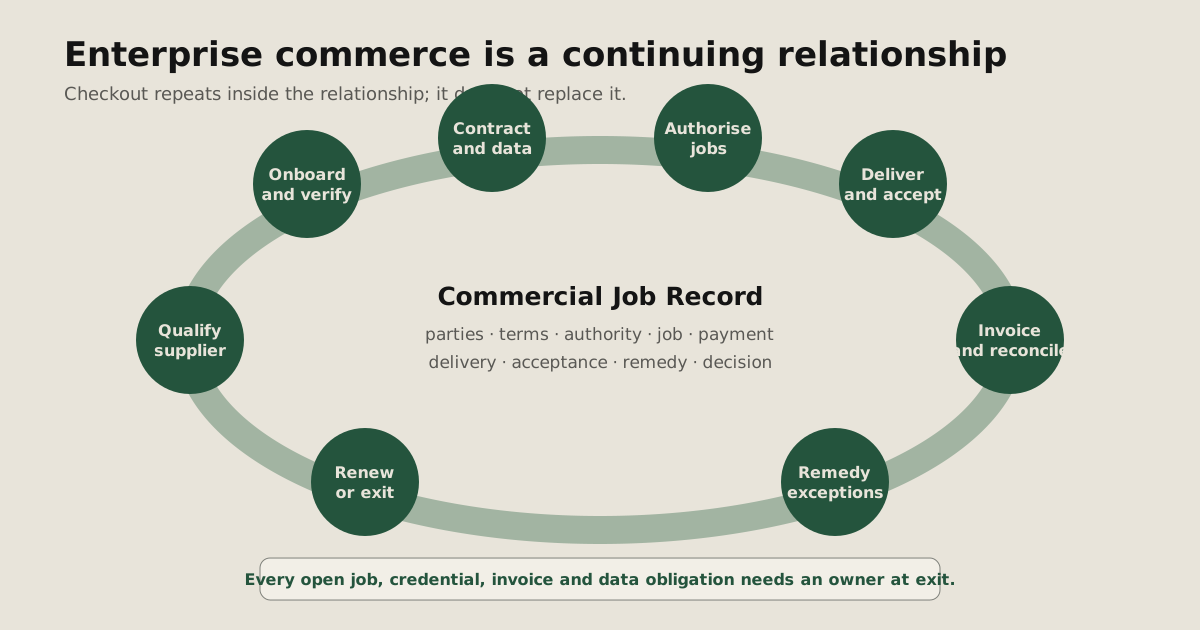
Governing autonomous trade requires an eight-stage commercial lifecycle:
1. Need & Intake        -> Business owner defines deliverable scope and acceptance test
2. Qualification        -> Procurement and security verify legal entity and data residency
3. Onboarding           -> Supplier profile, tax IDs, banking rails, and support SLAs established
4. Contract & Terms     -> MSA, SOW, or private offer executed with explicit liability terms
5. Task Authorization   -> Bounded job mandate issued with spend ceilings and expiration timestamps
6. Delivery & Inspect   -> Deliverable received, artifact hashed, and business acceptance signed
7. Invoice & Reconcile  -> Three-way matching across purchase order, receipt, and tax invoice
8. Renewal or Exit      -> Performance review, contract renewal, or complete data purge and offboarding
| Lifecycle stage | Authoritative organizational owner | Mandatory audit evidence required | Exception and remediation path |
|---|---|---|---|
| 1. Need and intake | Business Owner (Sponsoring Unit) | Explicit task deliverable, client identifier, completion deadline, acceptance criteria | Ambiguous requirements return to requester; automated execution is blocked |
| 2. Supplier qualification | Procurement, Security, and Privacy | Verified corporate entity, registration, risk tier, data processing regions, expiration | Verification failures or expired security certifications freeze qualification |
| 3. Vendor onboarding | Vendor Management Office | Verified banking details, tax registrations, SOC 2/ISO audits, support escalation paths | Incomplete due diligence halts account activation; prevents spend commitment |
| 4. Contract & terms | Legal Counsel and Contract Owner | Executed MSA, SOW, or marketplace private offer; liability caps, SLAs, dispute forum | Unnegotiated changes or ambiguous IP clauses require human legal intervention |
| 5. Task authorization | Business Sponsor and Finance | Job ID, purchase order reference, spending cap, time limits, and policy decision hash | Unauthorized actions halted at gateway; ambiguous transactions route to review |
| 6. Delivery & acceptance | Inspecting Business Analyst | Artifact SHA-256 hash, delivery timestamp, acceptance sign-off, or rework ticket | Defective, late, or partial deliverables trigger formal rework or rejection; never auto-accepted |
| 7. Invoice & reconciliation | Accounts Payable and Tax | Tax invoice, purchase order link, delivery receipt, payment record, general ledger match | Discrepancies open accounting exceptions; payments held pending resolution |
| 8. Renewal or exit | Contract Owner and Data Governance | Performance review, price amendments, verified data purge certificates, token revocation | Inadequate ROI halts contract renewal; exit requires verified deletion of enterprise data |
A transaction is financially reconciled only when the purchase order, delivery receipt, supplier tax invoice, and bank settlement record match under enterprise accounting policies. Warranty claims, data indemnity, and service-level credits remain active legal obligations that survive payment settlement.
The enterprise commercial backplane
Enterprise agentic commerce does not require inventing a new corporate operating system. It connects autonomous agent workflows into existing enterprise control planes:
| Enterprise control plane | Representative software platforms | Supplied operational capability | Client governance responsibility |
|---|---|---|---|
| Supplier qualification & risk | Oracle Procurement, SAP Ariba, ServiceNow Source-to-Pay | Vendor registration, compliance tracking, risk tiering, and performance evaluations | Establishing risk thresholds, auditing data policies, and enforcing periodic re-qualification |
| Contract lifecycle & terms | Ironclad, AWS Marketplace Private Offers, Microsoft Commercial Marketplace | Digital contract execution, amendment tracking, obligation registers, and marketplace terms | Negotiating liability caps, intellectual property ownership, and termination rights |
| Usage billing & entitlement | Stripe Billing, Metronome | Granular usage metering, subscription tier management, and real-time overage calculation | Verifying that billed usage meters align accurately with accepted business value |
| Invoicing & three-way matching | Oracle Financials, SAP Ariba Invoicing, Coupa | Automated three-way matching (PO, receipt, invoice), tax validation, and payment scheduling | Defining tolerance thresholds for price variances and managing dispute workflows |
| Enterprise support & SLAs | AWS Support Plans, Google Cloud Customer Care, Atlassian Customer Agreement | Tiered incident response times, technical support routing, and service-level credits | Documenting operational downtime and claiming contractual service credits |
| Marketplace settlement | Stripe Connect, Stripe Tax | Multi-party payment routing, Merchant of Record (MoR) management, and automated tax withholding | Defining platform liability for seller fraud, chargebacks, and negative account balances |
Applied walkthrough: managing AE-JOB-001 across the relationship lifecycle
The reference competitor briefing (AE-JOB-001) illustrates how an enterprise manages autonomous agent transactions from onboarding through contract termination:
1. Counterparty qualification and vendor onboarding
The corporate buyer registers the research provider as an approved vendor, capturing legal corporate identity, Australian Business Number (ABN), banking details, and designated executive contacts. Security and privacy teams verify that the supplier processes data within approved regions and maintains zero-retention policies for client-submitted context.
The software agent is registered as an authorized digital delegate; an internal research analyst is designated as the acceptance owner. Cloud compute, model inference, and web search APIs are logged as upstream sub-processors. Maintaining clear counterparty separation ensures that if an error occurs, liability is allocated correctly rather than attributed vaguely to "the AI."
2. Contract execution and mandate authorization
The parties execute a statement of work: one competitor briefing covering five named competitors and up to ten approved public sources, delivered within one business day for a fixed price of A$750 (inclusive of GST). External research purchases are capped at A$25. Valid rejections require correction within two business days or a full refund. Client materials must be deleted thirty days post-acceptance.
The finance team issues a purchase order (PO-2026-0881) and generates a cryptographic spending mandate. A payment credential cannot expand this budget; any proposed expenditure exceeding A$25 requires explicit human re-authorization.
3. Task execution and cost accounting
The brief initializes with job ID AE-JOB-001, linking the purchase order reference prior to execution. The agent operates within strict domain allowlists and spend ceilings. Every external API call logs an attempt ID and idempotency key.
The internal cost ledger records model tokens, search API fees, container runtime, and analyst review minutes. The supplier invoice ledger records the agreed A$750 deliverable fee and statutory GST. The two ledgers remain linked by job ID; raw token consumption is tracked as internal COGS, not passed through as unvetted customer charges.
4. Deliverable inspection and formal acceptance
The vendor delivers the completed briefing, accompanied by a cryptographic SHA-256 hash, primary source links, retrieval timestamps, and a revision log. An internal research analyst reviews the deliverable against the acceptance criteria, verifying that all five competitors are evaluated and facts are attributed to primary sources.
Upon verification, the analyst signs the acceptance record, transitioning the job to accepted. A provider API returning an HTTP 200 cannot write accepted into enterprise ledgers; only the designated human reviewer holds that authority.
5. Invoicing, three-way matching and reconciliation
The supplier issues a Peppol-compliant electronic tax invoice referencing PO-2026-0881 and job AE-JOB-001. Enterprise accounts payable executes automated three-way matching:
- Confirming the purchase order authorized A$750.
- Confirming the analyst signed the deliverable acceptance record.
- Confirming the tax invoice correctly itemizes A$681.82 base plus A$68.18 GST.
Once matched, the invoice is scheduled for payment via PayTo bank debit. Repeating the engagement for subsequent briefings requires verified acceptance of the prior job; repeat transactions cannot be authorized based on uninspected delivery.
6. Exception handling and failure containment
Suppose an upstream data source returns corrupted corporate financial figures, leading the agent to generate an inaccurate briefing that misrepresents a competitor's market share.
Under the contract, the research firm is the primary commercial counterparty. The enterprise halts active runs, preserves execution traces, and issues a formal rework notice. The supplier is contractually obligated to re-execute the research within two business days at zero additional charge. Because the deliverable was rejected, accounts payable places a payment hold on the pending invoice. Technical HTTP success logs cannot close the incident; the commercial contract dictates remediation.
7. Contract renewal or clean exit
At annual contract renewal, procurement evaluates cumulative performance: total deliverables accepted, first-pass success rates, human review minutes expended, and net contribution margin. Access credentials continue only under formal contract extension.
Upon contract termination, procurement confirms all open invoices are settled, legal counsel verifies the resolution of open warranty claims, IT revokes API keys, and data governance obtains verified cryptographic certificates proving the supplier purged client data from its systems.
The Enterprise Relationship Record
Production systems maintain an explicit operational record linking vendor contracts to individual task executions:
| Governance category | Operational data required | Core invariant |
|---|---|---|
| Counterparty identity | Legal corporate names, corporate registration IDs (ABN/ACN), tax IDs, authorized executive contacts | Display names, API keys, or cloud tenant IDs do not constitute legal identity |
| Vendor qualification | Procurement status, risk tier, security certifications (SOC 2, ISO 27001), privacy approvals, expiration dates | Unqualified or expired vendors cannot be selected for autonomous execution |
| Commercial contract | Master Services Agreement (MSA), SOW, or marketplace private offer ID, version, terms, renewal dates | Every autonomous transaction must reference an active, executed contract version |
| Authority mandate | Sponsoring principal ID, authorized agent ID, permitted tool allow-lists, spending caps, expiration | Financial credentials cannot widen the authorized scope of work |
| Budget & entitlements | Spend warning thresholds, hard budget ceilings, remaining credit balances, PO allocation | Budget alerts, hard spending caps, and payment clearing remain distinct controls |
| Task & deliverable | Job ID, business objective, external tool call receipts, deliverable artifact hash, timestamps | Tool invocations are internal execution logs, not customer deliverables |
| Business acceptance | Contractual criteria, inspecting reviewer ID, formal acceptance sign-off, or rework notices | Neither provider delivery nor financial settlement can auto-write acceptance |
| Invoicing & tax | Tax invoice ID, purchase order link, deliverable receipt link, statutory tax breakdown, due date | Billed invoice items must match accepted deliverables, not internal token metrics |
| Settlement & clearing | Payment rail, authorization hold ID, clearing confirmation, transaction hash, GL codes | Financial clearing cannot close open deliverable disputes or warranty claims |
| Data governance & exit | Processing regions, sub-processor registers, retention limits, cryptographic deletion certificates | Contract termination requires verified evidence of data and credential disposal |
| SLAs & support | Uptime commitments, support response tiers, incident ticket IDs, service credit ledgers | Uptime monitoring does not measure task deliverable quality or business acceptance |
| Liability & remedy | Contractual liability caps, IP indemnification, warranty terms, formal dispute arbitration forum | Every potential failure mode must map to an identifiable counterparty and remedy |
The canonical correlation architecture
The central Commercial Job Record acts as an append-only correlation ledger, linking authoritative records maintained across disparate enterprise systems:
Commercial Job Record
  -> Procurement System: Supplier ID, Qualification Status, Expiration Date
  -> Contract Repository: Executed MSA ID, SOW Terms, Liability Caps
  -> Policy Engine: Sponsoring Principal ID, Agent Mandate, Spending Ceiling
  -> Merchant Gateway: Order ID, Checkout State, Fulfillment Webhook
  -> Payment Clearing: Payment ID, Transaction Hash, Bank Reference
  -> Inspection Queue: Artifact SHA-256 Hash, Acceptance Sign-off ID
  -> ERP Accounts Payable: Purchase Order ID, Tax Invoice ID, GL Account Codes
  -> Risk & Legal: Incident Log ID, Service Credit Ledger, Dispute Case ID
When systems report conflicting statuses, the stricter governance boundary must govern. If accounts payable records a matched invoice while the inspection queue records a rejected deliverable, payment must be suspended until the business owner resolves the discrepancy.
The finance close and reconciliation gate
Before permitting an autonomous agent to execute commercial transactions, finance and procurement enforce a structured close gate:
| Transaction milestone | Legitimate financial conclusion | Mandatory audit evidence required | Accountability and control owner |
|---|---|---|---|
| Quoted | Financial exposure is known; no liability, payable, or cash movement has occurred | Itemized quote, vendor legal name, currency, fee schedule, expiration timestamp | Procurement / Sponsoring Unit; blocks order if terms are ambiguous |
| Ordered | Contractual commitment exists; deliverable fulfillment and payment remain open | Executed purchase order, signed mandate digest, merchant order confirmation | Procurement / Contract Owner; enforces duplicate order checks |
| Payment initiated | Funds are reserved or in transit; does not indicate settlement or deliverable acceptance | Authorization hold ID, payment intent reference, bank reference | Treasury / Payment Operations; halts workflow if settlement is ambiguous |
| Delivered, uninspected | Deliverable is transmitted; invoice payment remains subject to formal inspection | Artifact SHA-256 hash, delivery receipt, fulfillment timestamp | Service Owner / Inspecting Reviewer; cannot auto-write acceptance |
| Accepted, invoice open | Deliverable satisfies contract; financial invoice matching remains pending | Signed acceptance record, inspection notes, deliverable version ID | Accounts Payable / Controller; monitors aged un-invoiced receipts |
| Reconciled | Transaction closed: purchase order, delivery receipt, invoice, and payment match | Linked PO, delivery sign-off, tax invoice, bank clearing confirmation, GL entry | Financial Controller; sign-off authority segregated from execution |
| Disputed / Refunded | Transaction failed; formal remediation or clawback is underway | Dispute ticket ID, reason code, credit note, refund transaction reference | Dispute Operations / Legal Counsel; escalates unresolved claims |
The finance close pack requires linking seven core references: the job ID, authority mandate, merchant order receipt, deliverable acceptance sign-off, tax invoice, bank clearing hash, and open dispute log. Finance does not need to inspect conversational LLM prompts; it requires auditable commercial evidence.
Managing failure in multi-tier supply chains
When an autonomous workflow delegates work across external contractors, multi-tier failure is a primary operational risk:
Buyer Principal -> Internal Agent -> Managed B2B Service -> External Subcontractor
Every participant across this chain can report technical success while the ultimate customer deliverable fails. Managing multi-tier supply chains requires explicit operational protocols:
- Emergency halt authority: A designated corporate authority must possess the technical capability to revoke API credentials and cancel queued runs across all downstream vendors immediately.
- Investigation lead: The primary contracted vendor must lead incident investigation, coordinating forensic analysis across its upstream API providers.
- Contractual remediation: The primary vendor must provide rework, service credits, or refunds under agreed SLAs; it cannot deflect responsibility to its infrastructure sub-processors.
- Stakeholder notification: The enterprise must maintain procedures for notifying impacted clients, privacy regulators, or security bodies if data leaks occur within the sub-contractor chain.
- Operational continuity: The enterprise must maintain secondary fallback vendors or manual operational procedures to sustain critical business workflows during supplier outages.
Hyperscaler service agreements (AWS Customer Agreement, OpenAI Business Terms) explicitly allocate customer responsibility, output review obligations, and liability exclusions (AWS Customer Agreement; OpenAI Business Terms). Enterprise buyers must not assume that cloud providers or model vendors accept liability for downstream commercial errors.
The Australian institutional environment
Australian enterprises operate under specific domestic legal and financial frameworks:
- PayTo real-time debit mandates: Operated by Australian Payments Plus, PayTo allows corporate payers to establish legally enforceable account-to-account debit agreements with pre-authorized transaction limits (Australian Payments Plus, PayTo). A PayTo agreement governs banking payment execution; it does not authorize an agent to select vendors or confirm deliverable acceptance.
- Peppol structured eInvoicing: The Australian Taxation Office oversees the Peppol eInvoicing network, enabling automated, software-to-software exchange of standardized electronic tax invoices (ATO eInvoicing). Australian GST law mandates specific factual elements required on tax invoices, which apply equally to electronic machine-readable formats (ATO, GST ruling on tax invoices).
- Cross-border data disclosures: Australian Privacy Principle 8 (APP 8) mandates that Australian entities taking reasonable steps must ensure overseas recipients do not breach Australian Privacy Principles (OAIC APP 8 guidelines). Enterprises delegating autonomous tasks to overseas cloud models must audit sub-processor processing jurisdictions and verify data disposal procedures.
What enterprise commerce evidence establishes
Evaluating enterprise commerce claims requires matching evidence types to the operational conclusions they support:
| Operational evidence state | Verified capability established | Unresolved commercial uncertainty |
|---|---|---|
| Interface specification | Data schemas and API endpoints defined by standards bodies | Real-world multi-vendor adoption, software uptime, or commercial safety |
| Published cloud catalog | Vendor services publicly listed and accessible via developer portals | Enterprise contract terms, negotiated pricing, or custom data residency |
| Quoted commercial offer | Binding, time-stamped pricing returned for a specific task | Purchase order approval, payment clearing, or deliverable quality |
| Authorized purchase order | Enterprise spend authorized under corporate governance rules | Successful task fulfillment, deliverable acceptance, or post-purchase support |
| Invoiced & cleared transaction | Accounting invoice generated and payment cleared via banking rail | Whether the deliverable satisfied business requirements or was rejected |
| Delivered artifact | Deliverable transmitted to the purchasing client system | Factual accuracy, client acceptance sign-off, or dispute resolution |
| Accepted & reconciled job | Verified sign-off by an authorized reviewer; three-way match complete | Generalizability across unrelated business tasks or long-term vendor solvency |
| Recurring commercial trade | Subsequent purchase orders executed under an established contract | Unit economic profitability or enduring client satisfaction |
The trajectory of enterprise agentic commerce
Agentic commerce becomes enterprise commerce when individual transactions operate within governed, auditable, and legally defensible supplier relationships.
Payment protocols and usage meters provide essential technical plumbing. They do not ensure vendor qualification, verify deliverable quality, or resolve commercial liability. Long-term commercial defensibility belongs to enterprises that integrate autonomous workflows directly into authoritative ERP ledgers, enforce strict separation between technical execution and business acceptance, and maintain clear governance across the complete supplier lifecycle.
Every commercial relationship exists to deliver economic value. Chapter 15 examines the final economic layer: how autonomous agent services are packaged, monetized, and priced at margins that absorb execution retries, human oversight, and error remediation.
Sources and method
- Primary sources: Procurement, contract lifecycle, billing, and support documentation from SAP (Ariba supplier management), Oracle (Cloud Procurement supplier registration, three-way matching), ServiceNow (Source-to-Pay Operations), Ironclad, AWS (Marketplace Private Offers, Customer Agreement, Support Plans), Microsoft (Commercial Marketplace, DPA), Stripe (Billing, Connect, Invoicing, Tax), Metronome, Coupa, Google Cloud, Atlassian (Customer Agreement SLA), Australian Payments Plus (PayTo), the Office of the Australian Information Commissioner (APP 8), and the Australian Taxation Office (eInvoicing, GST rulings) checked as of 13 September 2026.
- Analytical frameworks: The Eight-Stage Enterprise Relationship Lifecycle, the Enterprise Commercial Backplane, the Enterprise Relationship Record, the Finance Close Gate, and the Multi-Tier Supply Failure Model are original analytical structures developed to evaluate enterprise agent governance.
- Evidence boundaries: Documentation establishes declared vendor features, platform terms, and protocol capabilities. Enterprise software uptime, three-way matching automation reliability, and deliverable quality require empirical validation on customer workloads.
- Institutional references: Australian legal, privacy, and taxation frameworks (PayTo, ATO eInvoicing, OAIC APP 8) provide the regulatory context for domestic enterprise trade.
- Editorial record: Published by Agentic Economy, Perth, Western Australia. Updates and corrections are logged via the editorial record.
Back to the report hub · Previous: payment credentials and settlement · Next: agent services and business models.